Choosing the best exterior windows from China requires more than comparing prices and frame colors. It demands careful attention to climate, installation quality, factory controls, and verified performance. A window that looks impressive in a showroom may leak air during a winter storm or admit excessive heat in summer.
Helen Sanders, Ph.D., a recognized fenestration and building-science expert, emphasizes that “a window is only as good as its installation.” That principle matters when evaluating Chinese manufacturers. Strong products should include tested U-factor, solar heat gain coefficient, air leakage, water resistance, and structural performance data. Look for thermally broken aluminum, Low-E insulated glass, durable seals, and precise drainage channels. Ask whether testing followed recognized international standards, not only a supplier’s marketing claims.
Factory experience also matters. Review production photographs, quality-control records, sample approvals, and export history. A serious supplier should explain how glass spacers, corner joints, hardware, and powder coating are inspected. Request physical samples before placing a large order. Small details reveal weaknesses.
The cheapest option is rarely the best option.
Our first assumption may be too simple: Chinese windows are not one uniform category. Some factories produce highly engineered systems, while others mainly compete on appearance and price. Even excellent exterior windows can fail when measurements, flashing, or anchoring are poor. This guide will compare performance, materials, certifications, customization, and after-sales support. It will also acknowledge an uncomfortable truth: reliable selection takes time, and no supplier deserves trust without evidence.
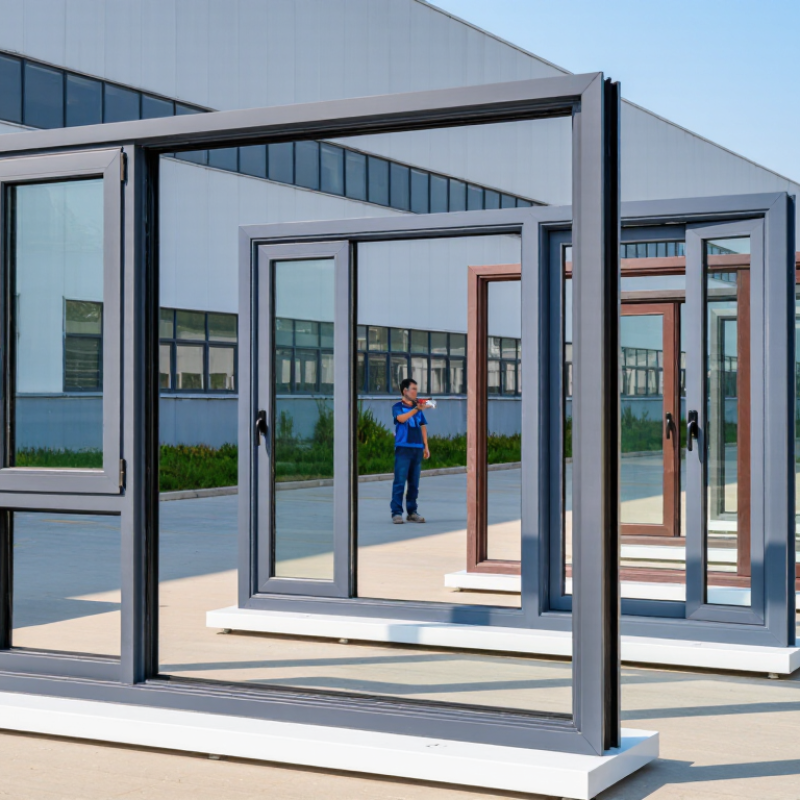
China’s exterior window factories commonly produce uPVC, aluminum, thermally broken aluminum, and aluminum-clad systems. Each suits a different building condition.
uPVC tilt-and-turn windows offer good insulation and practical ventilation. Their multi-chamber frames can reduce cold bridging, although frame quality varies between suppliers. Aluminum casement windows are slimmer and stronger, making them useful for large openings. Thermal-break aluminum performs better in hot or cold climates because an insulated polyamide strip separates the interior and exterior metal. Sliding windows save space, but their overlapping sashes usually seal less tightly than casement designs. Fixed windows provide the best air tightness, though they cannot ventilate a room.
China also manufactures awning, folding, lift-and-slide, and curtain-wall windows. Lift-and-slide systems suit wide balconies and modern villas, but their rollers need accurate installation. Folding windows create a broad opening, yet hardware alignment can become a maintenance issue. I have seen attractive specifications fail because drainage channels were too shallow. Details matter.
The U.S. Department of Energy estimates that windows can cause 25–30% of residential heating and cooling energy use. The IEA’s 2023 Global Status Report says buildings consumed about 30% of global final energy in 2022. Therefore, buyers should check U-values, solar heat-gain coefficients, air leakage, glass spacing, low-E coatings, and installation tolerances. Double glazing is common; triple glazing is better for severe climates, but not always worth its added weight and cost. Performance depends on the complete window, not glass alone.
The best Chinese exterior windows begin with suitable materials, not attractive photographs. Thermally broken aluminum reduces heat transfer through the frame. uPVC can provide strong insulation at a lower cost. For coastal buildings, powder-coated aluminum needs careful corrosion testing. Glass should match the climate and building orientation. Low-E double glazing suits many projects, while laminated glass improves safety and sound control. Tempered glass handles impact and temperature changes better. Frame corners must be firmly joined. Weak drainage paths often cause trouble during heavy rain.
Tips: Request air, water, and wind-load test reports before ordering. Check whether testing follows recognized ASTM, EN, or ISO methods. Ask for sample sections, hardware details, and warranty terms. Measure wall openings twice. Installation errors can defeat excellent window performance.
A reliable supplier should explain profile thickness, glass composition, gasket quality, and drainage design clearly. Factory inspection should include random opening tests and visual checks for scratches. Site teams must seal joints with compatible membranes and weather-resistant sealant.
Poor foam placement remains a common weakness. It looks minor. It is not.
Performance figures require context. A low U-value may not reflect the whole window assembly. I would also question unusually cheap quotations, even when certificates appear complete. Standards improve consistency, but documentation cannot replace physical inspection. The strongest choice balances thermal performance, structural strength, maintenance needs, and local weather exposure.
Choosing exterior windows from China requires more than comparing frame prices.
Energy performance should come first. The U.S. Department of Energy estimates that windows account for about 25–30% of household heating and cooling energy use. Ask for a low U-factor, a suitable solar heat gain coefficient, and verified low-emissivity glazing. NFRC rating documents can help confirm these figures. Lower U-factor usually means better insulation.
Weather resistance is equally practical. Look for test results based on ASTM E283 for air leakage, ASTM E331 for water penetration, and ASTM E330 for structural performance. These tests matter during heavy rain and strong coastal winds. Check drainage paths, corner welds, gaskets, and the quality of installation instructions. A well-rated window can still leak if the sill is poorly flashed. That detail is often ignored.
Security needs measurable evidence, not vague claims. Ask whether the complete window assembly has passed a recognized forced-entry standard, such as EN 1627, and review the tested resistance class. Inspect multipoint locks, reinforced keepers, laminated glass, and hinge protection. The glass should not be treated as an afterthought. In practice, I would request independent laboratory reports, serial-linked samples, and warranty terms before ordering. Some supplier documents look convincing but lack traceable test conditions. That is a weakness worth questioning. Temperature, wind exposure, and local building codes can also change the best specification.
Choosing exterior windows from China requires more than comparing catalog photos and prices. A reliable evaluation begins with measurable performance. Ask for U-values, air leakage, water penetration, and wind-load results. These figures should match your climate and building design. Coastal projects need stronger corrosion resistance and careful drainage. Cold regions need insulated frames and low-emissivity glazing. Small details matter. Inspect a sample corner, gasket, locking point, and drainage path before placing a large order.
Supplier credibility depends on evidence, not confident emails. Request factory photos, production records, quality-control procedures, and recent third-party test reports. The reports should identify the exact frame profile, glass type, hardware, and configuration. Ask for traceability. A generic certificate proves little. A factory visit, even by video, can reveal storage conditions, cutting accuracy, and assembly discipline. Check whether workers follow written inspection steps. Also review packaging, installation instructions, spare-part support, and response times after delivery.
Price comparisons can be misleading when profiles, glazing, screens, and hardware differ. Request a detailed quotation with clear tolerances and testing responsibilities. A small pilot order can expose problems before a full shipment. Install one window and test its operation after rain and temperature changes. No supplier is perfect. I have seen attractive samples hide weak seals and inconsistent finish quality. I would rather accept a slower quotation than a fast promise. That judgment can still be wrong, so keep written records, approved samples, and independent inspections throughout the project.
| Evaluation Dimension | Recommended Benchmark | What to Verify with the Supplier | Why It Matters for Exterior Windows | Relevant Test Method or Reference |
|---|---|---|---|---|
| Whole-Window Thermal Performance | Target U-factor: ≤ 1.6 W/m²·K for a good double-glazed unit; ≤ 1.0 W/m²·K for high-performance triple glazing. | Request certified whole-window U-factor calculations or test reports, not only the center-of-glass value. Confirm frame, spacer, glass, sash, and size used in the calculation. | Lower U-factor means less heat transfer and generally better heating and cooling efficiency. | NFRC 100, ISO 10077-1, or an applicable national calculation standard. |
| Solar Heat Gain | Select a Solar Heat Gain Coefficient according to climate: approximately 0.25–0.40 for cooling-dominated areas; approximately 0.40–0.60 where passive solar gain is useful. | Check the complete glazing specification, including low-emissivity coating, tint, gas fill, pane arrangement, and spacer type. | Controls unwanted summer heat while allowing useful daylight and, in some climates, beneficial winter solar gain. | NFRC 200 or ISO 52022-1. |
| Air Leakage | Prefer tested air leakage of ≤ 1.5 m³/(h·m²) at 75 Pa for the complete window. | Ask for the tested air-leakage rate, test pressure, window size, opening type, and whether the result applies to a production-equivalent assembly. | Low air leakage improves comfort, energy efficiency, moisture control, and resistance to wind-driven drafts. | ASTM E283, EN 1026, or an equivalent accredited laboratory method. |
| Water Penetration Resistance | No uncontrolled water penetration at the project's specified test pressure. | Confirm the water test pressure and duration, drainage design, sill details, weep-hole arrangement, and whether the test used the same glass and hardware as the quotation. | Water resistance is essential for protecting wall cavities, insulation, finishes, and interior furnishings. | ASTM E331, EN 1027, or the applicable project specification. |
| Structural Wind Resistance | The design pressure must be calculated from the project's wind speed, building height, exposure, location, and window position. No single universal pressure is suitable for every project. | Request structural calculations or test results for the exact frame series, reinforcement, glass size, mullion spacing, and anchorage method. | Prevents excessive deflection, glass breakage, frame failure, and anchorage problems during severe wind events. | ASTM E330/E330M, EN 12211, or local structural design requirements. |
| Glass Safety | Use fully tempered or laminated safety glass wherever required by the applicable building code; use laminated glass where post-breakage retention or fall protection is required. | Verify glass type, thickness, heat treatment, interlayer type, safety markings, edge quality, and the location of safety-critical glazing. | Safety glass reduces injury risk and laminated glass can retain broken pieces after impact. | Applicable local building code, EN 12150, EN 14449, ASTM C1048, or ASTM C1172. |
| Insulating Glass Unit Quality | Use sealed insulating glass with verified spacer, desiccant, sealant, and gas-fill specifications. Argon-filled units commonly use approximately 90% or higher initial fill when specified. | Check sealant compatibility, spacer material, gas-fill declaration, dew-point results, production date, and evidence of seal durability. | Good edge sealing helps prevent condensation between panes, gas loss, and premature insulating-glass failure. | EN 1279 series, ASTM E2188, ASTM E2189, or ASTM E2190. |
| Frame Material and Reinforcement | The frame should have documented alloy, wall-thickness, thermal-break, or reinforcement specifications appropriate to the opening size and design load. | Request section drawings, material certificates, profile wall thickness, thermal-break dimensions, reinforcement details, and corner-joint construction. | Frame geometry and reinforcement affect strength, thermal performance, alignment, and long-term operation. | Project structural calculations and the applicable aluminum, uPVC, or material-specific product standard. |
| Surface Finish and Corrosion Resistance | Specify a finish suitable for the exposure category. Coastal or industrial locations require stronger corrosion-control measures than sheltered inland locations. | Confirm coating type, coating thickness, pretreatment process, color tolerance, adhesion, and salt-spray or cyclic-corrosion test results where relevant. | Proper finishing helps resist fading, chalking, blistering, oxidation, and corrosion of exposed components. | ISO 9227 for salt-spray testing; AAMA 2603, 2604, or 2605 where applicable to organic coatings. |
| Hardware and Operating Durability | Hardware should be corrosion-resistant and rated for the sash weight, opening size, usage frequency, and local environmental exposure. | Verify hardware material, load rating, adjustment range, replacement availability, locking points, hinges, rollers, handles, and test-cycle results if required. | Quality hardware supports smooth operation, compression of seals, security, and serviceability over the product life. | Applicable hardware manufacturer testing and project-specific durability requirements. |
| Acoustic Performance | Set the target by project noise conditions. A complete window rating such as Rw or STC is more useful than the glass-only rating. | Request a laboratory rating for the complete frame-and-glass configuration, including opening type and tested size. | Sound reduction depends on the complete assembly, air leakage, glass thickness, laminated interlayers, and installation. | ISO 10140, ISO 717-1, ASTM E90, or ASTM E413. |
| Factory Quality Control | The supplier should maintain documented incoming-material inspection, in-process checks, final inspection, traceability, and nonconformance procedures. | Review quality manuals, inspection forms, calibration records, batch traceability, sample approval procedures, and corrective-action records. | Consistent production control reduces variation between approved samples and delivered windows. | ISO 9001-based quality-management procedures and project inspection plans. |
| Independent Testing and Certification | Use reports from an accredited laboratory that identify the exact profile, glass, hardware, dimensions, and test configuration being quoted. | Check laboratory accreditation, report validity, product description, specimen dimensions, test sequence, failures, and any limitations or conditions. | Independent evidence is more reliable than brochure claims or tests performed only on unrelated product configurations. | ISO/IEC 17025 laboratory accreditation and the standards listed for each performance category. |
| Installation Compatibility | The window, anchorage, perimeter seal, sill flashing, drainage, and wall interface must be designed as one installation system. | Request installation drawings, anchor spacing, allowable tolerances, shim requirements, flashing details, sealant specifications, and method statements. | Even a high-performance window can leak or fail if it is incorrectly measured, anchored, flashed, or sealed. | Project installation specification, manufacturer instructions, and applicable local building code. |
| Commercial and After-Sales Reliability | Require a written warranty, spare-parts commitment, replacement procedure, packaging standard, inspection plan, and clearly defined remedies for defects. | Confirm warranty coverage for frames, coating, insulating-glass seal failure, hardware, and installation; also verify response times and documentation responsibilities. | Clear contractual responsibilities reduce risk when defects, transit damage, measurement errors, or installation issues occur. | Purchase contract, approved drawings, inspection-and-test plan, and agreed warranty schedule. |
Choosing exterior windows from China starts with the building, not the catalog. A coastal apartment needs corrosion-resistant frames and strong drainage paths. A northern home needs low heat transfer and reliable seals. In noisy urban areas, laminated glass can reduce traffic disturbance. Every choice should match the local climate, wall structure, and ventilation plan.
For new residential buildings, thermally broken aluminum frames offer strength and clean sightlines. Multi-point locking improves security and compression around the gasket. Large openings require careful review of glass weight, wind pressure, and hardware capacity. High-rise projects also need documented performance for air leakage, water penetration, and structural pressure. Ask the manufacturer for test reports, installation drawings, and sample sections. Certificates alone are not enough.
Renovation projects need different thinking. Existing openings are rarely perfectly square. Measure several points, then allow practical adjustment space. I have seen attractive windows fail because installers ignored sill drainage. That detail matters. For schools and offices, prioritize durability, easy cleaning, and acoustic control over decorative complexity. Factory quality can be consistent, but communication may still break down over tolerances or packaging. Use approved drawings and inspect samples before mass production. The cheapest quote is not always the lowest project cost. Sometimes, a modest design performs better.